California Approves New Workers' Compensation Advisory Rates Effective September 1, 2026
The California Insurance Commissioner has approved new Workers' Compensation Insurance Rating Bureau (WCIRB) advisory pure premium rates effective September 1, 2026. These approved advisory rates serve as an important benchmark for workers' compensation pricing throughout California and provide brokers with valuable insight when preparing clients for upcoming renewals.
Approved California Advisory Rates (9/1/2026) |
| | | |
| Approved Rates (Eff 9/1/2025) | Approved Rates (Eff 9/1/2026) | % Change |
Average Advisory Rate | 4.29 | 4.55 | +6.06% |
| | | |
Based on WorkCompare's year-over-year comparison of all WCIRB approved advisory pure premium rates. |
It is important to remember that advisory pure premium rates are not necessarily the final rates a business owner will pay. Pure premium rates represent the WCIRB’s estimate of expected losses and loss adjustment expenses by classification. Insurance carriers may apply their own pricing models, credits, debits, expenses, underwriting judgment, and profit considerations when determining final premiums.
Still, advisory rate movement often provides an important early signal about broader market conditions and the direction of workers’ compensation pricing.
Summary of Approved Changes
Earlier this year, the WCIRB released its proposed advisory rates. Following review by the California Department of Insurance, the Insurance Commissioner approved the final rates, which take effect September 1, 2026. This article has been updated to reflect the approved rates.
Across all California classifications, the average approved advisory rate increased from 4.29 to 4.55, representing a 6.06% year-over-year increase.
The approved changes vary significantly by classification. While many class codes show moderate movement, others are seeing substantial increases or decreases that could meaningfully affect insurance costs for California employers.
Several transportation, construction, manufacturing, and service-related classifications are among those seeing notable upward movement. Some lower-hazard clerical and professional classifications also experienced meaningful percentage changes despite having relatively low advisory rates.
For brokers and agents, these changes create an opportunity to proactively discuss workers' compensation costs with clients before clients begin renewing under the new rates.
Why This Matters to Business Owners
For many California businesses, workers’ compensation is one of the largest recurring expenses. Even relatively small advisory rate changes can materially affect the price employers pay for coverage.
Businesses operating in classifications with larger increases may experience meaningful cost pressure at renewal, especially when combined with payroll growth, experience modification changes, or carrier underwriting adjustments.
At the same time, some classifications are seeing relatively stable or reduced advisory rates, which may create opportunities for brokers and employers to reassess carrier options and improve overall program competitiveness.
Turning Rate Changes Into Client Conversations
One of the biggest challenges for brokers is helping clients understand what rate changes actually mean for their business.
This is where year-over-year advisory rate comparisons become valuable.
Instead of discussing workers’ compensation pricing in general terms, brokers can show:
· How projected renewal pricing compares with expiring premium
· Whether advisory rates are relatively stable or moving significantly
· How carrier pricing compares across the broader California market
The approved advisory rates are now available in WorkCompare. Use a Pre-Quote Estimate to help clients understand how these market changes may affect upcoming renewals.
Detailed Class Code Rate Comparison
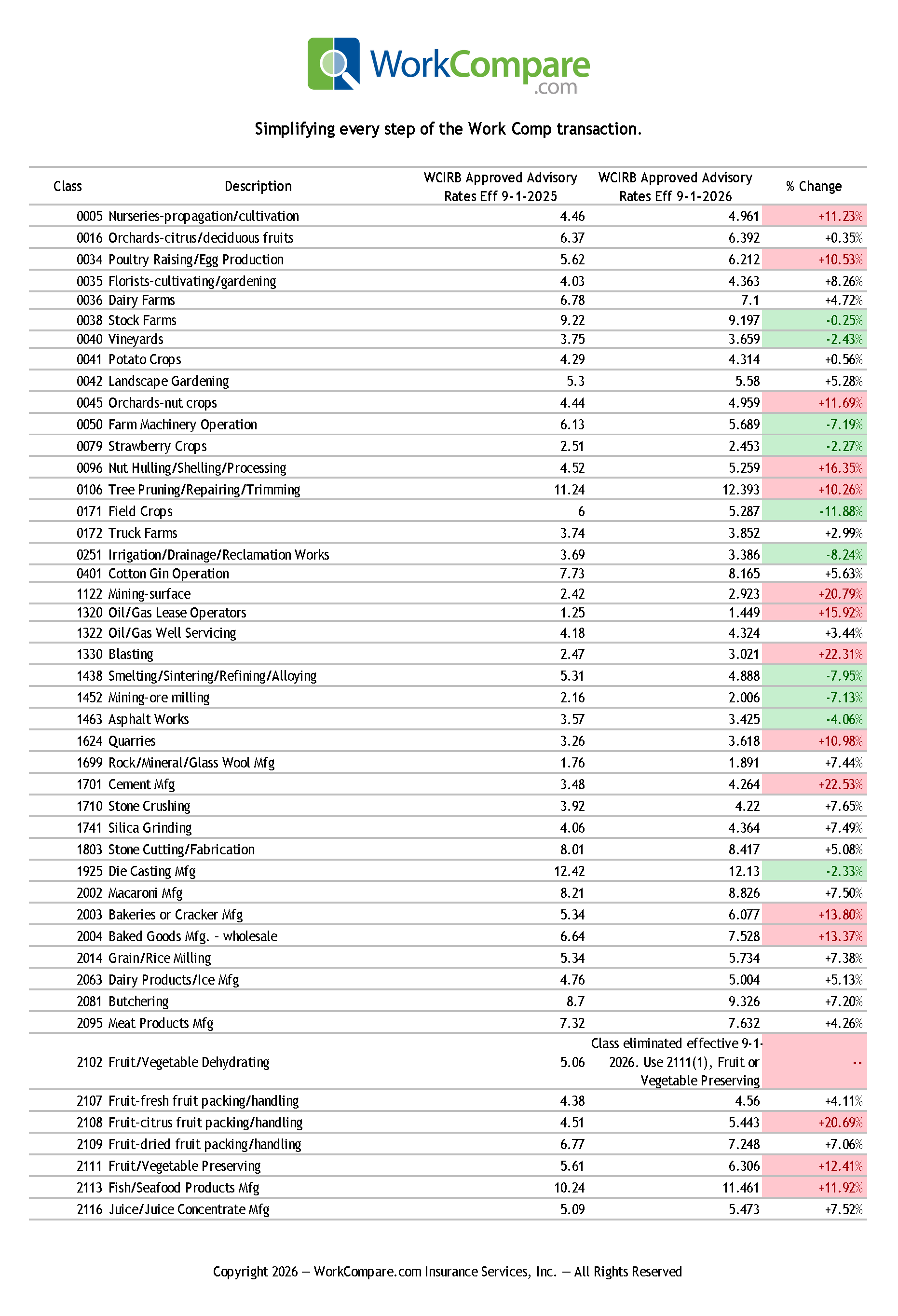
The following table compares approved advisory rates effective 9/1/2025 to the WCIRB’s approved advisory rates for 9/1/2026 by governing class code.
Conclusion
The WCIRB’s approved advisory pure premium rates for September 1, 2026 suggest continued pricing movement across many California workers’ compensation classifications.
The impact will vary significantly depending on industry, payroll distribution, governing classifications, and carrier pricing strategy. Brokers and agents should review these approved changes carefully and begin discussing potential impacts with clients well before renewal.
WorkCompare.com provides tools that make it easier to analyze advisory rates, compare carrier pricing, and guide California employers toward informed workers’ compensation buying decisions.
Make Market Changes Work for You
Don’t be surprised by rate changes — prepare for them. With WorkCompare, you can generate a Pre-Quote Estimate and:
· Project pricing across class codes before quoting
· Educate clients on trends that impact their premium
· Deliver faster, more confident advice
Already a subscriber? Log in to Get an Estimate or Get an ExMod
New to WorkCompare? Create a Free Account and Try PQE Today.
Click here to join our mailing list.
WorkCompare.com — Simplifying every step of the Work Comp transaction.